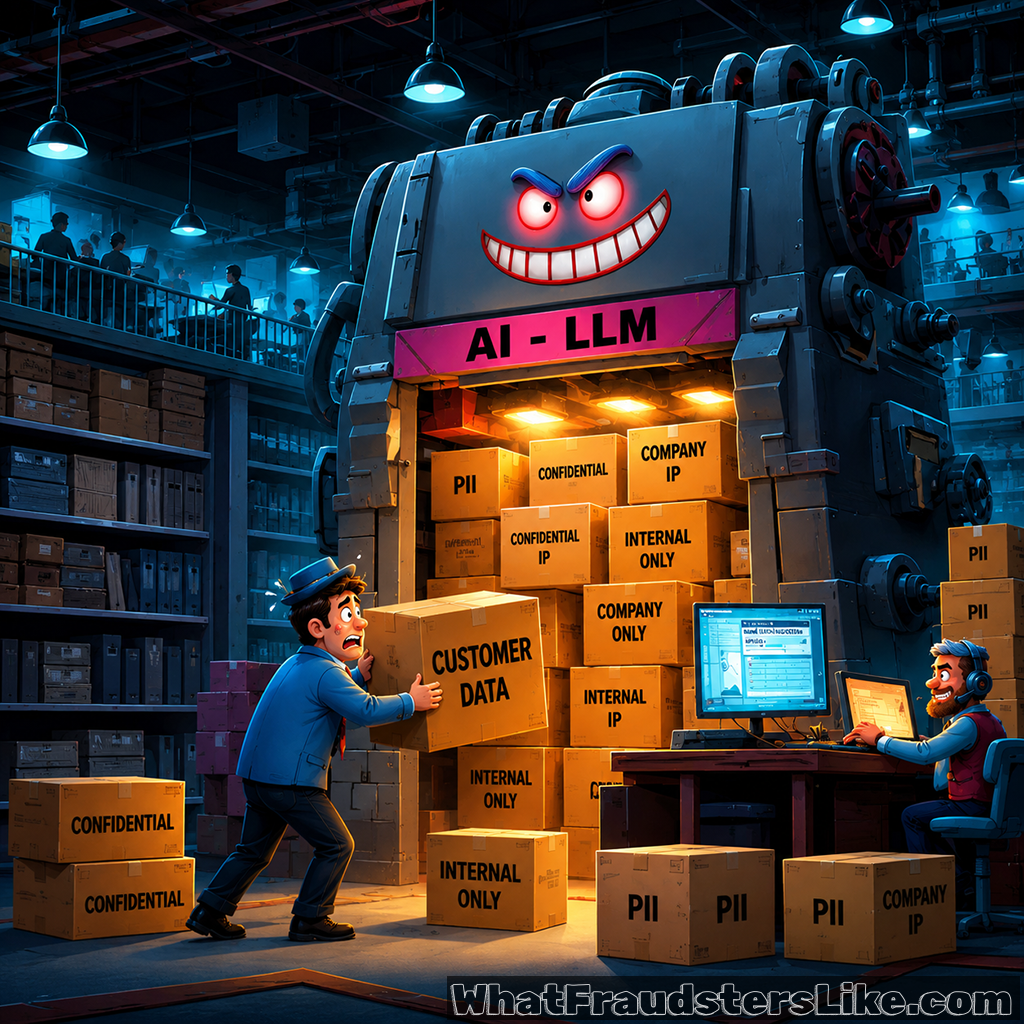
Attackers don't always break through hardened security. Employees open the side doors - one "helpful" AI tool at a time.
Shadow AI is any AI tool or service used at work without IT approval. Fraudsters love it - not because they built it, but because your employees hand over the data for free.
How the invisible AI risk plays out at work:
✍️ Writing and drafting - Staff draft emails, reports, and proposals using public AI. Internal strategy, client names, financial projections, and legal positions land in the prompt - potentially in a model's training data - with no data agreement.
🗂️ Document processing tools - OCR, scan enhancers, invoice processors, and AI contract review receive actual business documents - contracts, ID scans, financial records - uploaded to third-party servers no one in IT has reviewed.
💻 Code generation and debugging - Developers paste proprietary source code, internal APIs, and database schemas into AI coding assistants. Architecture details and occasionally credentials travel with them.
🎙️ Meeting transcription - AI note-takers join calls and record everything - strategy, M&A, personnel matters - all stored on external servers outside any corporate policy.
📊 Data analysis and reporting - Financial spreadsheets, HR records, and customer lists uploaded to AI for analysis or visualization. The data leaves the organization the moment it hits submit.
📎 AI browser extensions - Writing assistants request permission to "read and change all data on websites you visit" - meaning every email, intranet page, and client portal interaction logged to a server IT has never audited.
Gartner estimated up to 40% of IT spending occurs outside central IT oversight.[ref] Microsoft found over 60% of employees use non-approved AI tools at work.[ref] A Cyberhaven study found workers pasting corporate data into ChatGPT at a rate representing millions of documents per year.[ref]
Shadow AI is a convenience problem. Attackers are very patient about it.
What can we do:
For organizations:
- Create a fast-track tool request process - a simple form, quick assessment, clear timeline. Make the approved path faster than the shadow one.
- Build an approved AI tool list that meets your data security standards.
- Implement DLP controls to detect sensitive data submitted to unauthorized AI, and CASB tools to see which AI applications employees actually use.
- Update your Acceptable Use Policy to cover AI tool usage.
For employees:
- Before using any AI tool for work, ask: who owns this data once submitted? Has IT approved it? If you find a useful tool, flag it for review rather than adopting it quietly.
- Treat the AI prompt box like a public message board. If you wouldn't post it there, don't paste it into an unapproved AI.
Fraudsters don't need zero-days when convenience creates blind spots for free.